The school will run over two weeks, with four minicourses plus two invited talks and six grad students's presentations. It stresses on varied topics in Differential Geometry, ranging from Minimal Surfaces to Hyperbolic Geometry and Rigidity.
Invited lecturers:
Daniel Monclair -
(Institut de Mathématique d'Orsay, France)
Gilles Courtois -
(Sorbonne Université – C. Pierre et Marie, France)
Gérard Besson -
(Institut Fourier, France)
José Espinar -
(Universidad de Granada, Spain)
Geodesic flows in anti-de Sitter geometry
Anti-de Sitter geometry is the study of Lorentzian manifolds of constant negative curvature. A Lorentzian metric on a manifold is a field of quadratic forms of signature (-,+,...,+), a contrast with Riemannian metrics that are positive definite. Note that while the isotropy group SO(n) of Riemannian geometry is compact, the group SO(1,n) of Lorentzian geometry is not. This non compactness often leads to interesting dynamics of groups acting on Lorentzian manifolds.
The aim of this course is to describe both similarities and differences between anti-de Sitter and hyperbolic manifolds, with an emphasis on the dynamical systems that arise from their studies: isometry groups and geodesic flows.
Dynamical and geometrical rigidity of horospheres (shared with Besson)
Horospheres are limits of spheres with radii tending to infinity.
We will investigate the intrinsic geometry of horospheres in manifolds of negative curvature.
A central theme will be to describe how geometric quantities evolve under the geodesic flow,
for example the curvature and also of the connection of the horospheres.
This will lead to geometric characterizations of closed manifolds of constant negative curvature.
Dynamical and geometrical rigidity of horospheres (shared with Courtois)
Horospheres are limits of spheres with radii tending to infinity.
We will investigate the intrinsic geometry of horospheres in manifolds of negative curvature.
A central theme will be to describe how geometric quantities evolve under the geodesic flow,
for example the curvature and also of the connection of the horospheres.
This will lead to geometric characterizations of closed manifolds of constant negative curvature.
Minimal and Constant Mean Curvature Surfaces in R3: Existence and Uniqueness.
Outline of Three Classes.
Class 1 – Minimal Disks and Existence Theorems: Introduction to minimal surfaces, Plateau’s problem (existence of least-area spanning disk) and classical existence/uniqueness results (Douglas–Rado theorem, Rado’s convex boundary theorem).
Class 2 – Alexandrov Reflection and CMC Spheres: Constant mean curvature (CMC) surfaces, the Alexandrov reflection method, and the Alexandrov uniqueness theorem (closed embedded CMC surfaces in R3 are round spheres). We also cover the (strong) maximum principle for elliptic PDE and its application to surfaces.
Class 3 – Conformal Parameterizations and Hopf–Nitsche Theorems:Holomorphic/Weierstrass representation of minimal surfaces, the Hopf differential and Hopf’s theorem on CMC spheres. We discuss capillary surfaces (CMC disks meeting a sphere or plane) and Nitsche’s theorem (any H=const$ disk in a ball is totally umbilic). Each class builds on differential geometry and basic PDE, mixing analytic methods (Class 1) with geometric classification (Classes 2–3).
Objetivos de Aprendizaje y Prerrequisitos.
Clase 1 – Objetivos: Comprender qué es una superficie mínima (curvatura media cero) y formular el problema de Plateau: existencia de una superficie de área mínima con contorno dado. Conocer el teorema de existencia de Douglas–Rado y la unicidad bajo condiciones convexas (teorema de Rado). Prerrequisitos: Cálculo en varias variables y ecuaciones en derivadas parciales (p.ej. Laplaciano), nociones básicas de superficies inmersas en R3.
Clase 2 – Objetivos: Entender el método de reflexión de Alexandrov y su uso para demostrar unicidad y simetría de superficies CMC cerradas. Formular y probar el teorema de Alexandrov: cualquier superficie embebida, compacta y de curvatura media constante en R3 es una esfera. Aplicar el principio del máximo (Hopf) para comparar superficies de igual H. Prerrequisitos: Conocimiento de curvatura media, formas fundamentales, y el principio del máximo clásico para ecuaciones elípticas.
Clase 3 – Objetivos: Aprender la representación conforme de superficies mínimas (Weierstrass) y la diferencial de Hopf holomórfica para superficies CMC. Demostrar que cualquier esfera CMC inmersa es redonda (teorema de Hopf), usando que la diferencial de Hopf es holomorfa. Estudiar superficies capilares de tipo disco: en particular, enunciado del teorema de Nitsche (un disco inmerso de CMC en una bola es totalmente umbilical). Prerrequisitos: Conocimiento de funciones holomorfas y parametrización conforme en superficies, comprensión de la diferencial de Hopf
Class 1 – Minimal Disks and Existence Theorems: Introduction to minimal surfaces, Plateau’s problem (existence of least-area spanning disk) and classical existence/uniqueness results (Douglas–Rado theorem, Rado’s convex boundary theorem).
Class 2 – Alexandrov Reflection and CMC Spheres: Constant mean curvature (CMC) surfaces, the Alexandrov reflection method, and the Alexandrov uniqueness theorem (closed embedded CMC surfaces in R3 are round spheres). We also cover the (strong) maximum principle for elliptic PDE and its application to surfaces.
Class 3 – Conformal Parameterizations and Hopf–Nitsche Theorems:Holomorphic/Weierstrass representation of minimal surfaces, the Hopf differential and Hopf’s theorem on CMC spheres. We discuss capillary surfaces (CMC disks meeting a sphere or plane) and Nitsche’s theorem (any H=const$ disk in a ball is totally umbilic). Each class builds on differential geometry and basic PDE, mixing analytic methods (Class 1) with geometric classification (Classes 2–3).
Objetivos de Aprendizaje y Prerrequisitos.
Clase 1 – Objetivos: Comprender qué es una superficie mínima (curvatura media cero) y formular el problema de Plateau: existencia de una superficie de área mínima con contorno dado. Conocer el teorema de existencia de Douglas–Rado y la unicidad bajo condiciones convexas (teorema de Rado). Prerrequisitos: Cálculo en varias variables y ecuaciones en derivadas parciales (p.ej. Laplaciano), nociones básicas de superficies inmersas en R3.
Clase 2 – Objetivos: Entender el método de reflexión de Alexandrov y su uso para demostrar unicidad y simetría de superficies CMC cerradas. Formular y probar el teorema de Alexandrov: cualquier superficie embebida, compacta y de curvatura media constante en R3 es una esfera. Aplicar el principio del máximo (Hopf) para comparar superficies de igual H. Prerrequisitos: Conocimiento de curvatura media, formas fundamentales, y el principio del máximo clásico para ecuaciones elípticas.
Clase 3 – Objetivos: Aprender la representación conforme de superficies mínimas (Weierstrass) y la diferencial de Hopf holomórfica para superficies CMC. Demostrar que cualquier esfera CMC inmersa es redonda (teorema de Hopf), usando que la diferencial de Hopf es holomorfa. Estudiar superficies capilares de tipo disco: en particular, enunciado del teorema de Nitsche (un disco inmerso de CMC en una bola es totalmente umbilical). Prerrequisitos: Conocimiento de funciones holomorfas y parametrización conforme en superficies, comprensión de la diferencial de Hopf
Invited speakers:
Viveka Erlandsson -
(University of Bristol, Britain)
Counting curves bounding subsurfaces of given genus
Counting curves (i.e. closed geodesics) on a hyperbolic surface is a classical problem, and Huber proved in the 60s that the number of geodesics of length at most L is asymptotic to e^L/L as L grows. This result has been generalized in many directions. Mirzakhani showed, among other things, that the number of (simple) geodesics bounding an embedded surface of fixed genus grows polynomially in L. In this talk we will discuss the growth of (non-simple) geodesics bounding an immersed surface of fixed genus, or more generally those of fixed commutator length. This can also be viewed as a generalization or refinement of results by Phillips—Sarnak and Katsura-Sunada who obtained the asymptotic growth of geodesics that are trivial in homology. Our methods boil down to counting certain immersed graphs in the surface, and also result in a simple proof of Huber’s original theorem, which I hope to cover, time allowing. This is joint work with Juan Souto.
Françoise Dal'Bo -
(Université Rennes 1, France)
There will be food and refreshments in between talks and during the break.
The event is funded by CSIC-Uruguay and International Research Laboratory IRL-2030 Instituto Franco-Uruguayo de Matemática e Interacciones (IFUMI).
Supported by IMERL-FING and CMAT-FCien, UdelaR.
CMAT - UdelaR, Uruguay
salvarez@cmat.edu.uy
Françoise Dal'Bo
Université Rennes 1, France
dalbo@univ-rennes1.fr
Martín Reiris
CMAT - Universidad de la República, Uruguay
mreiris@cmat.edu.uy
Almost everything you have always wanted to know about the suspension of the Euclidean 2-Torus by a hyperbolic matrix of Sl(2,Z).
Schedule:
| Mo 2 | Tue 3 | Wed 4 | Thu 5 | Fri 6 | |
|---|---|---|---|---|---|
| 13:00-14:30 | Monclair | Espinar | Students: J. Nario V. Garcia J. Piriz |
Monclair | |
| 14:30-15:30 | Snacks & Refreshments | Snacks & Refreshments | Snacks & Refreshments | Snacks & Refreshments | Armand Riera |
| 15:30-17:00 | Espinar | Monclair | Erlandsson | Espinar | |
| 19:00-23:00 | Party! |
| Mo 9 | Tue 10 | Wed 11 | Thu 12 | Fri 13 | |
|---|---|---|---|---|---|
| 13:00-14:30 | Courtois | Besson | Students: P. Erniaga A. Castro L. Bermúdez |
Courtois | |
| 14:30-15:30 | Snacks & Refreshments | Snacks & Refreshments | Snacks & Refreshments | Snacks & Refreshments | Valerio Assenza |
| 15:30-17:00 | Besson | Courtois | Dal'Bo | Besson | |
| 19:00-23:00 | Recreation |
There will be food and refreshments in between talks and during the break.
Registration
Registration is free and helps to organize the meeting better. We kindly ask you to register below (even if you have already confirmed your participation verbally or by email).The event is funded by
Supported by IMERL-FING and CMAT-FCien, UdelaR.
Organizers:
Sebastién AlvarezCMAT - UdelaR, Uruguay
salvarez@cmat.edu.uy
Françoise Dal'Bo
Université Rennes 1, France
dalbo@univ-rennes1.fr
Martín Reiris
CMAT - Universidad de la República, Uruguay
mreiris@cmat.edu.uy
Venue of the school:
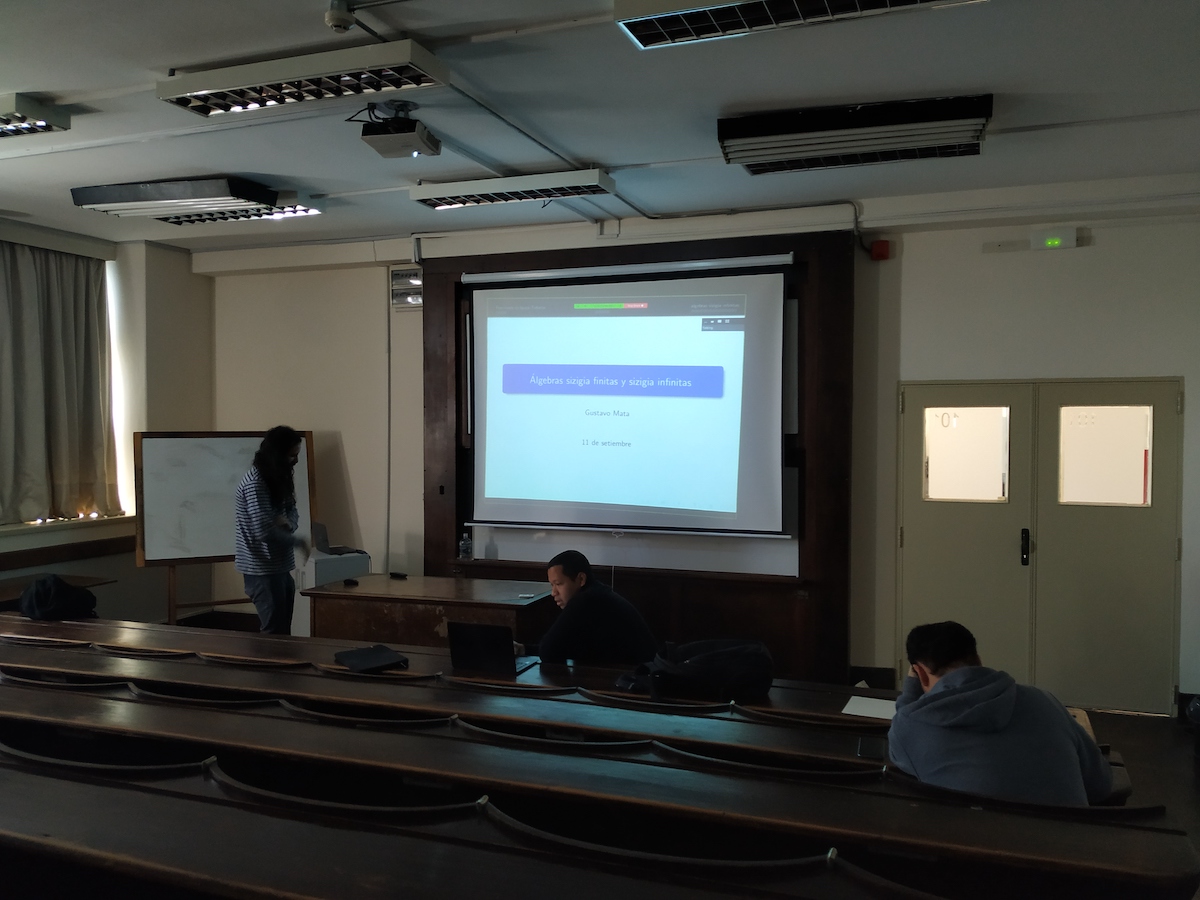
Lecture room 101 of the. math department, inside the Engineering building.
MAP place
Useful information
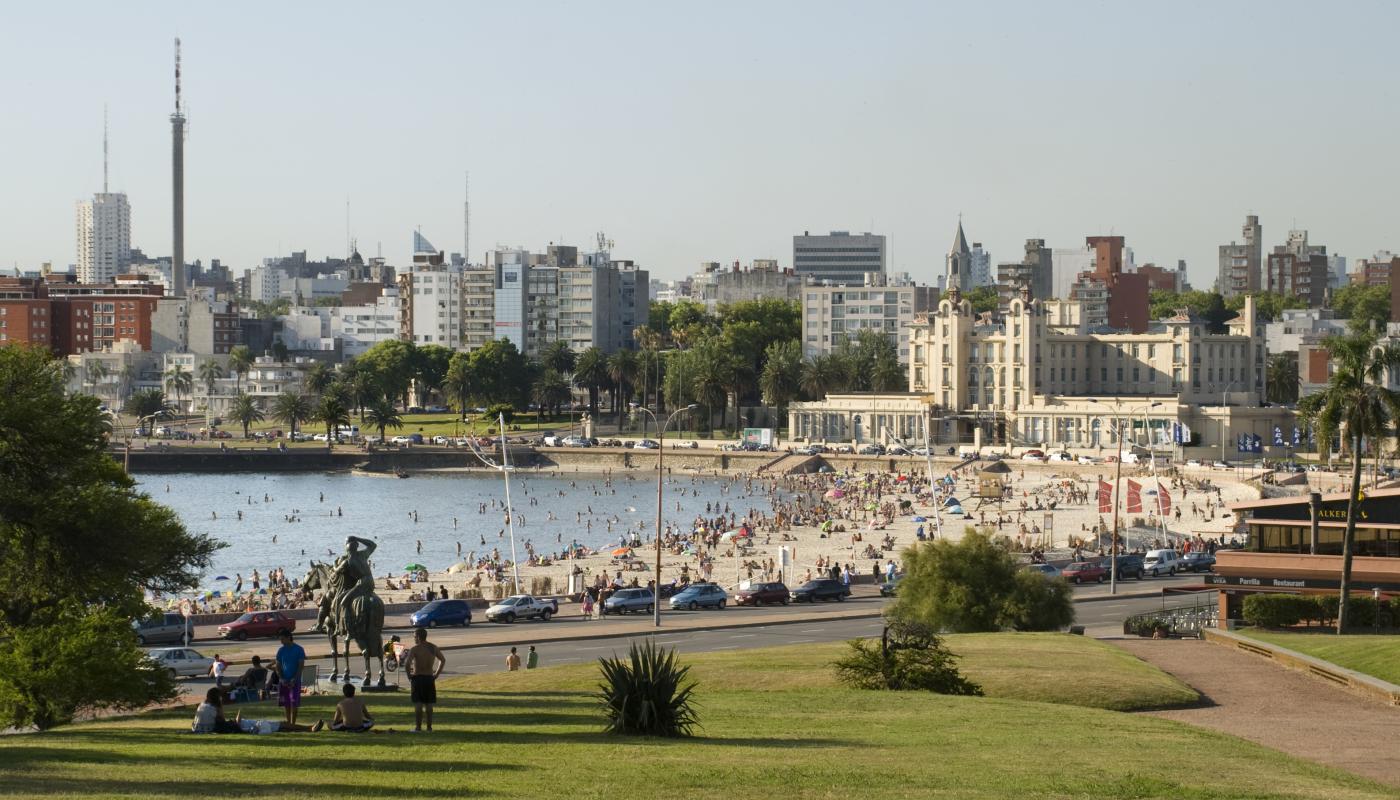
Download here a PDF with further information about Parque Rodó neighborhood (where the lecture hall is located) and Montevideo city: places to visit, transportation, restaurants, prices, safety, etc.